

Eight Misconceptions I Had About Chanukka
What I Got Wrong Before a Japanese Ex-Christian Became Jewish

Is it Chanukkah? Or Hanukkah? The answer lies in a Hebrew consonant English doesn’t have — the guttural ח. When my mother first heard me practice it, she paused and asked, “Do women also speak like that?”
Just like the spelling, my early assumptions about Chanukkah came in every possible variation. So here are my top eight misconceptions — one for each night of Chanukkah (or Hanukka).
1. “Chanukkah Is the Jewish Christmas.”
Growing up in Japan, I hadn’t heard of Chanukkah at all. When I moved to New York and saw giant Chanukkiot displayed next to Christmas trees, I assumed it was the Jewish Christmas. Something merry and holy. But it’s far from it. It remembers a historical battle and isn’t even a biblical holiday.
And Chanukkah doesn’t reliably overlap with Christmas anyway. In my lifetime, I’ve seen it fall everywhere from the famous 2013 “Thanksgivukkah” to years when I was lighting candles on New Year’s Eve. It’s because we follow the Jewish calendar, not the Gregorian one.
2. “The Chanukkiah Is a Decoration.”
At first, I thought people put their Chanukkiot in windows for the same reason we string up holiday lights. A festive decoration. But it’s actually a public statement of Jewish identity.
3. “Chanukkah Is a Biblical Holiday.”
I assumed everything “Jewish” holiday was biblical and religious. Not this one. Chanukkah is post-biblical, rooted in history and survival. Our tradition even involves a bit of “gambling” — or rather, pretending to play a game. Legend has it that when the Greek rulers outlawed Jewish learning, Jews would pretend to gamble with dreidels to disguise the fact that they were studying Torah.
4. “The Dreidel Is Just a Top.”
Physics is not my forte. To me, it looked like any top. Then my husband explained the uneven weight distribution and the famous wobble — perfect for a game that relies on chance. At home we make edible dreidels out of marshmallows and chocolate kisses. They’re cute. They do not spin.
5. “Jewish Kids Love Chanukkah as Much as Kids Love Christmas.”
This is the most obvious misconception. What kid doesn’t love Santa—the tree, the lights, the music? The truth is, many Jewish kids in America have sat on Santa’s lap at least once. And some Jewish parents put up a Christmas tree (what some call a “Chrismukkah bush”), too.
And you think this is all about the kids? Not at all.
During Judaism studies (conversion classes), we seriously discussed the “Christmas dilemma.” In my opinion, it’s the second most complicated conversion topic — right after circumcision.
Did you know that Judaism traditionally encourages Jews to work on Christmas so their Christian colleagues can take the day off? It’s considered a mitzvah—a kind, considerate act.
Another well-known Jewish tradition is going to the movies and eating at Chinese restaurants on Christmas—historically because those places were often open when everything else was closed.
6. “We Have to Give Eight Real Gifts.”
As a new convert, the idea of eight gifts nearly sent me into a panic. So I had to ask my friends, and I learned most families give practical gifts on most nights — socks, books — things they need for their kids anyways, and save the “real” gift for one night.
The best part wasn’t the gifts anyway; it was the quiet nightly rhythm — lighting the candles and singing Maoz Tsur together.
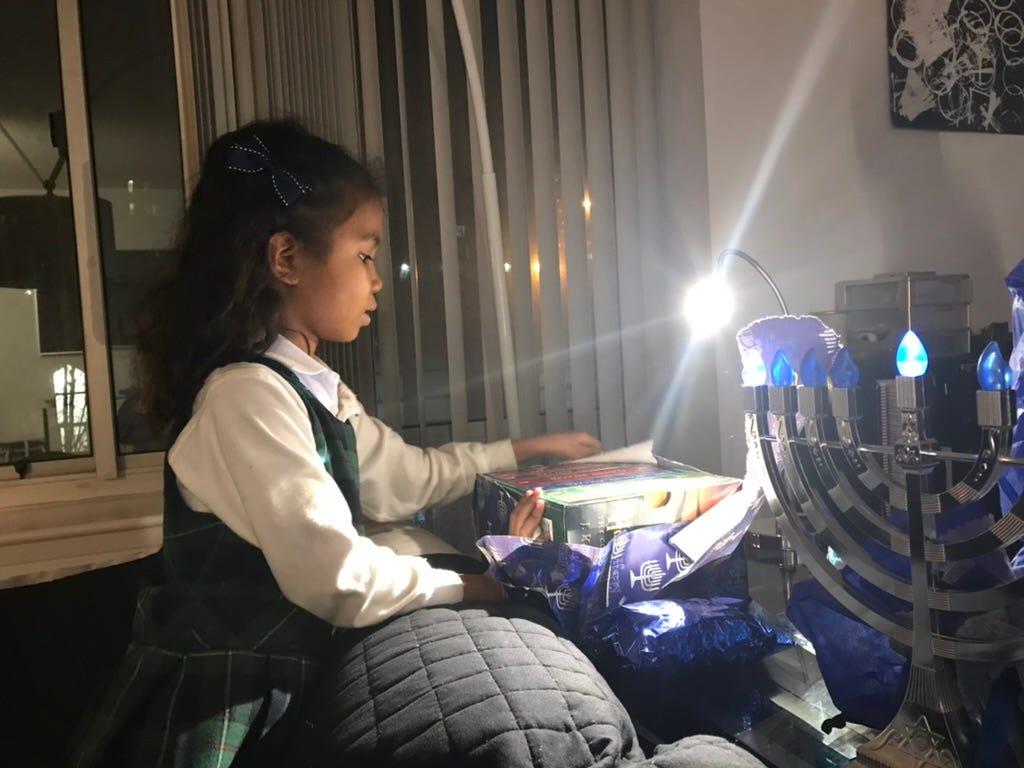
(Our daughter receiving her “main” Chanukkah gift)
7. “Jewish People Like Fried Food.”
I went to my first Latke Party at Ted Reichman’s home in Brooklyn many years ago. I could not get over how oily the whole evening was. Back then, I didn’t know anything about Chanukkah or Judaism, so I was so surprised that Jewish people actually had a party around fried food theme.
The Channukka miracle: there was only enough oil for one night — yet it lasted eight. So this is why Chanukkah foods are fried.
Honestly, any holiday that encourages fried food is fine by me.
8. “Christmas Songs Were Written by Christians.”
“White Christmas”? “Let It Snow”? And many Christmas songs were written by Jewish writers.
Jews can love Christmas, write Christmas classics, and still remain fully Jewish.
As for me, yes — we’ll put up the tree, not for our 14-year-old, but for my husband. That feels entirely fair. And I’ll be in the kitchen making my Okonomi-Latke, the Japanese–Jewish fusion nobody asked for but everyone enjoys.
Chappy Chollidays!
Wonderful post. Thank you for educating us.
Wait… what? You drop that in the last paragraph as an aside??? You are duty bound to share your Okinomi-latke recipe. This is a true moral imperative.😎